Spirit of Adventure
Adventure Time: Side Quests
Cartoon Network Studios
Adventure Time characters Finn and Jake return to their origins in a fresh take on the series.
When a development executive asked Nate Cash if he had any ideas for an Adventure Time spinoff, the executive suggested they could even choose not to have main characters Finn and Jake in it. “I was like, oh no, I really, really love 12-year-old Finn from seasons one and two,” says Cash.
Set in the post-apocalyptic Land of Ooo, Adventure Time ran from 2010 to 2018, and Cash served as a Storyboard Supervisor, Creative Director, and Supervising Director on the original. He describes young Finn as a bombastic “righteous barbarian,” an unpolished version of a sweet mythic hero, and so he centered the idea of Adventure Time: Side Quests on a collection of new adventures tucked within the early timeline of the original series, paying homage to when the show was still exploring and had an impromptu feel.


“Everybody’s in that nice little bubble of time where it was just innocence and running around and going on adventures,” says Supervising Director Victor Courtright. He adds that the early seasons were flexible with a mindset of pure exploration, allowing the creative team to tell any kind of story.
Working with characters both old and new, Cash, who is now an Executive Producer, says that they were careful not to contradict or disrupt anything that had become lore in the show. For example, later in the original series the character Peppermint Butler grew a little nefarious with the dark arts. However, they didn’t want Finn and Jake to be aware of that in Side Quests, so they could only hint at it, which becomes an Easter egg for fans.
I wasn’t sure if I could write in Finn and Jake’s voice after many years off, but it was like getting back on a bike and going for a whimsical ride around a deep blue lake.—Writer and Storyboard Artist Jesse Moynihan
Many of the new crew worked on the original series, and each discovered rewards while also facing issues unique to their roles. Writer and Director Nikki Yang, who voices the characters BMO and Lady Rainicorn, felt like she was reuniting with old friends, but from a story perspective, she says it’s difficult to come up with something new for characters that have been around for so long.
“I was kind of hesitant to return to the world of Ooo,” says Writer and Storyboard Artist Jesse Moynihan. “I wasn’t sure if I could write in Finn and Jake’s voice after many years off, but it was like getting back on a bike and going for a whimsical ride around a deep blue lake.”
Writer and Character Designer Tom Herpich adds: “I went back to being a Character Designer for Side Quests, which I hadn’t done since Season 1 of the original. I got to revamp a bunch of designs I originally drew 15 years ago. It was nice to fix some little mistakes, but also nice to take stock of how far the show and myself have come since then. It’s been a wild ride.”
In creating Side Quests, Courtright notes that they incorporated a lot of classic animation techniques, including cel, stop motion, and paper cutout, as well as pixel art. Cash describes how Courtright even transferred a scene to VHS, placed it in a VCR, and then “started kicking the VCR to get actual VHS distortion on it.” The rationale for this, they say, is because the original series allowed that kind of experimentation with guest directors.


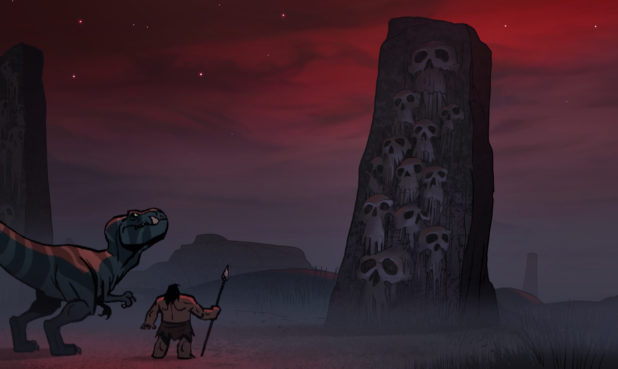
But Art Director Nick Cross notes that Cash wanted to make sure Side Quests had a look that would separate it from the original. While he didn’t want to change the design of the characters, early in development Cash talked with Cross about taking the original black-and-white layouts and “rendering them in a very painterly, Frank Frazzetta oil painting, fantasy style and doing a lineless, almost Samurai Jack treatment to the characters.”
At times, though, once final animation came back from the partner studio, “there would be issues that we couldn’t foresee in the pre-production phase with characters blending into certain backgrounds,” says Cross. To address this, they used a software called DaVinci to help with final color and resolve any issues with readability of characters as well as adding extra lighting effects. Cross calls it a powerful tool for its ability to quickly isolate areas of color to help shift the tint or tone and adjust the final picture.

For Cash another goal was being open to new voices, which was a hallmark of the original series. It helped that many of the new people working on the show either grew up watching Adventure Time, or it was a formative experience in their creative growth. With Side Quests, he says, they don’t want to disappoint fans who already know the series, while also trying to appeal to new audiences.
“I feel so honored to be a small part of Adventure Time for the new generation of kids,” says Background Painter Carissa Nakata, who recalls how special it felt when she first watched the series 16 years ago as a fan. “I hope [new fans] experience the same kind of joy!”
Adventure Time and Adventure Time: Side Quest images courtesy of Cartoon Network Studios.

Fan Favorite
Sofia the First: Royal Magic
Disney Jr.
Character growth and advances in technology shape the return of a Disney princess from Sofia the First.
When asked what sparked bringing back Disney Jr.’s Sofia the First, Executive Producer Craig Gerber says: “It really boiled down to the ongoing fan response to the original series.” Having developed the series, he explains that when the show first aired in 2012, the primary audience was children. “But little kids,” he says, “don’t post about what they love on social media.” It was only years later that he began to see whether or not the show stood the test of time. Songs would go viral on TikTok, and people recounted their love for Sofia on other social media platforms.

Sofia the First ran for four seasons, with more than 100 episodes and two primetime specials. The title character was a commoner who unexpectedly became a princess (and Disney’s first little girl princess). Initially, as Gerber created the new series, there was a thought that it would take place at the same Royal Prep School Sofia had graduated from at the end of the original. But in development it became clear to Gerber that the story should take Sofia beyond that, and so they decided to have her attend the Charmswell School for Royal Magic where she learns to master her magical powers.
The trick to revisiting a show that already exists is figuring out what absolutely must be kept and what should change.—Executive Producer Craig Gerber
Notably, Royal Magic comes with an entirely new look. Gerber explains that when the original series was made, CG animation was somewhat limited for television. They used toon-shading, making the CG appear flatter and hand-drawn, to evoke classic 2D Disney animated features and create a fairytale storybook feel. “We called it two-and-a-half D at the time,” he says.
For Gerber, a significant challenge was the new Sofia. They had to bring her model into the updated CG style and still retain the feel of the original. “When you break it down and you take all the surfacing off of the original Sofia model, it’s a weird model,” he says. “She has a really big head. Her eyes are set really far apart. She had almost no nose to speak of. And if you lit that in the way that modern animated movies are lit in CG, she would look bizarre.” He explains that the style worked in the original “because there were no shadows.” In the end, it took intensive work with modeling and surfacing to achieve the effect he wanted.

Advances in CG also played a major role in upping the production value. “The original Sofia was rendered with Mental Ray,” says Art Director Francis Giglio. “The new series is rendered with Arnold, which is a newer software that delivers more cinematic lighting.” In addition, other advanced software enabled them to create more complex surfacing textures, including skin, fur, foliage, metallic elements, and special effects, resulting in quality more akin to a feature film.


As for Charmswell, it was the biggest CG set built for any show that Gerber had produced and Giglio had worked on. “We designed the set at Disney Television Animation, but it was built in CG by ICON Creative Studio,” says Gerber. “They initially were going to carve up the campus into smaller sets but ultimately decided to create one big set that included the entire school campus and surrounding grounds.”
“No matter where you were on campus, on the horizon line above the trees, you’d see the school,” adds Giglio.
“The trick to revisiting a show that already exists,” says Gerber, was figuring out what absolutely must be kept and what should be changed: “It was a unique challenge to come back to this world and try to honor everything that people loved about it, while still making it fresh and exciting.”
Sofia the First and Sofia the First: Royal Magic images courtesy of Disney Jr.